What are the Ethics of Anti-War Art?
Two “Krieg” Portfolios. Medium, its message, memory understood through Kollwitz’s and Dix’s contemporaneous works. Their similarities, their striking differences and the meaning behind each
I. Dix's Neun Holzschnitte (Nine Woodcuts), 1919-1920
Before I dive into how two artists arrived at their respective Krieg portfolios, we must understand each artists work prior to their respective Krieg series. There is an almost ironic exchange of mediums that occurs in the two contemporaries prior to addressing the subject of “The Great War”. Chronologically, Dix came to woodcut first, and only briefly. Neun Holzschnitte (1919–1920) counts among his very first prints, and he made woodcuts only between 1919 and 1920 before giving up the medium entirely. What he produced in that window was not war imagery at all. Many of the woodcuts pay homage to the restless, nocturnal energy of metropolitan street life. Dix exploits the graphic contrasts of black and white to suggest the electric charge of an illuminated nighttime populated by clanging streetcars, prowling cats, and striding, grasping streetwalkers around whose grotesquely exaggerated sexuality everything else revolves.
Dix saw a vigor and vibrance of Wiemar period Germany celebrating some of the more liberal aspects of society that emerged in the early 1920s and it has a sensibility that has hints of Art Nouveau, Art Deco and other modernist geometric predelections emerging outside of Germany blended with the signature German Expressionist vibrations in the mark making that radiate emotive energy.
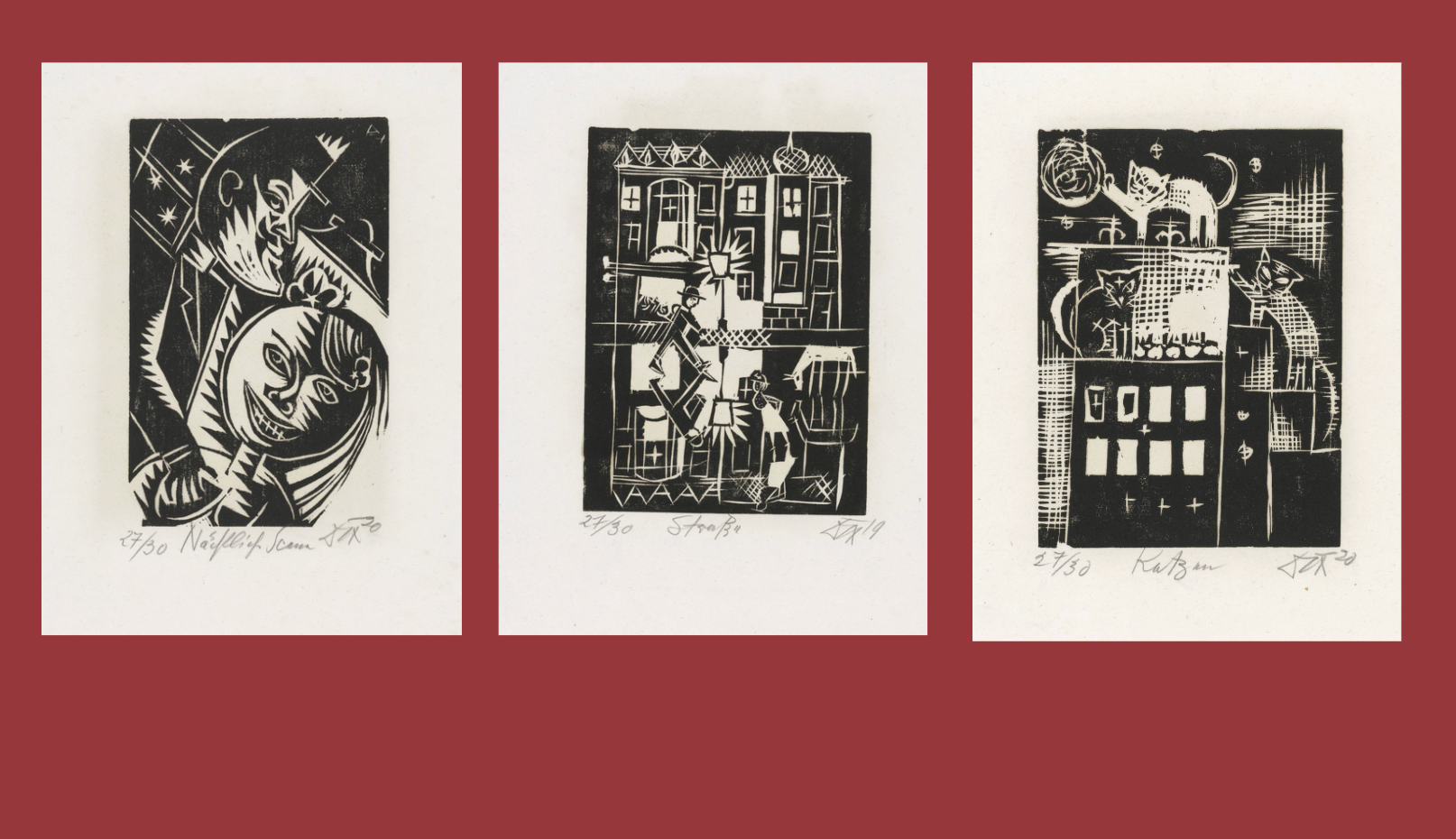
Selection of three of the nine woodcuts depicting lighter scenes of urban life from Dix’s 1919-1920 series. Left to right: “Nocturnal Scene (Man and Woman)”. “Street”. “Cats”
II. Kollwitz Claims the Medium for Absolute Darkness
Kollwitz's move to woodcut was not stylistic borrowing from her collegues who were all dabbling in the medium by the early 1920s. After the death of her son Peter (aged 18) in the opening months of “the Great War” she struggled to find a medium where she felt confident. She bemoaned that her two mediums of mastery, copperplate etching and stone lithography. These two printmaking mediums are both technically the most challenging and chemically the most complex. As far as ways of creating print editions, these “are the serious genres.”
Even a master can fight themselves in the challenge of lithography and copperplate and she felt she no longer knew how to draw. She claimed she was in a decade long transition from 1914-1924 of learning to completely redraw. The ideas for a Krieg series started as early as 1918 but these early states were abandoned, compositions in flux and even an emergence of charcoal and white “charcoal” to create the seeds for what would eventually become the final Krieg series. She tried both stone lithography and copperplate first but abandoned the effort.
By 1920, seeing Dix and Barlach making different impressions with woodcut, she identified : There is no mid-tone in woodcut. Material is either at the surface or has been carved or chiseled away. The ink will roll uniformly across the top of the plate. Every square millimeter will be either be inked or not—off or on. “There is only darkness” she is to have said about the black fields of uncarved material within woodblock.
She materialized horrific despair as dense fields of black that dominate her compositions in the early 1920s. With an economy of means, realized with extraordinary effort of revisions over years while in an artistic silence in published editions since the start of the war and death of her son. The eventual triumph of selecting woodcut became something that removed the technical and chemical barriers of stone lithography and copper plate. Woodcut was not metal or Bavarian limestone. It was paradoxically “softer” than either, but the effort of gouging and chiseling wood is far more effort and struggle than scratching metal or drawing with oily sticks on lithography stones.
For her woodcuts quietly convey overwhelming physical and psychological oppression. She had noted in her diary that "pain is completely dark" and found, in the woodblock's resistance to nuance, the only material that could tell the truth. The woodcut becomes a physical catharsis, a permanent medium (once carved, there is no “shading” or filling in material, it is a permanent mark in the wood. She finally expressed that she had found a medium that would suit her new series and she started to create stark study state drawings to plan her seven wood “plates”.
III. The Body as Psychology: Hands and Faces
The key feature in every plate of Kollwitz’s Krieg is the dual magnetic poles of the face and the hands. The faces carry a psychological truth that is raw biological response without metaphor. The hands are always elements in action, clutching, holding, protecting, encircling, embracing, grasping, or covering the agonized face. The body often receeds into the dark and becomes an interior reckoning both psychologically and in the perspective of the space and image composition.
By contrast Dix's Der Krieg will later render the body as a structural element in his works, a site of physical destruction. He documents the trench soldier’s flesh and the surrounding mud and wire.
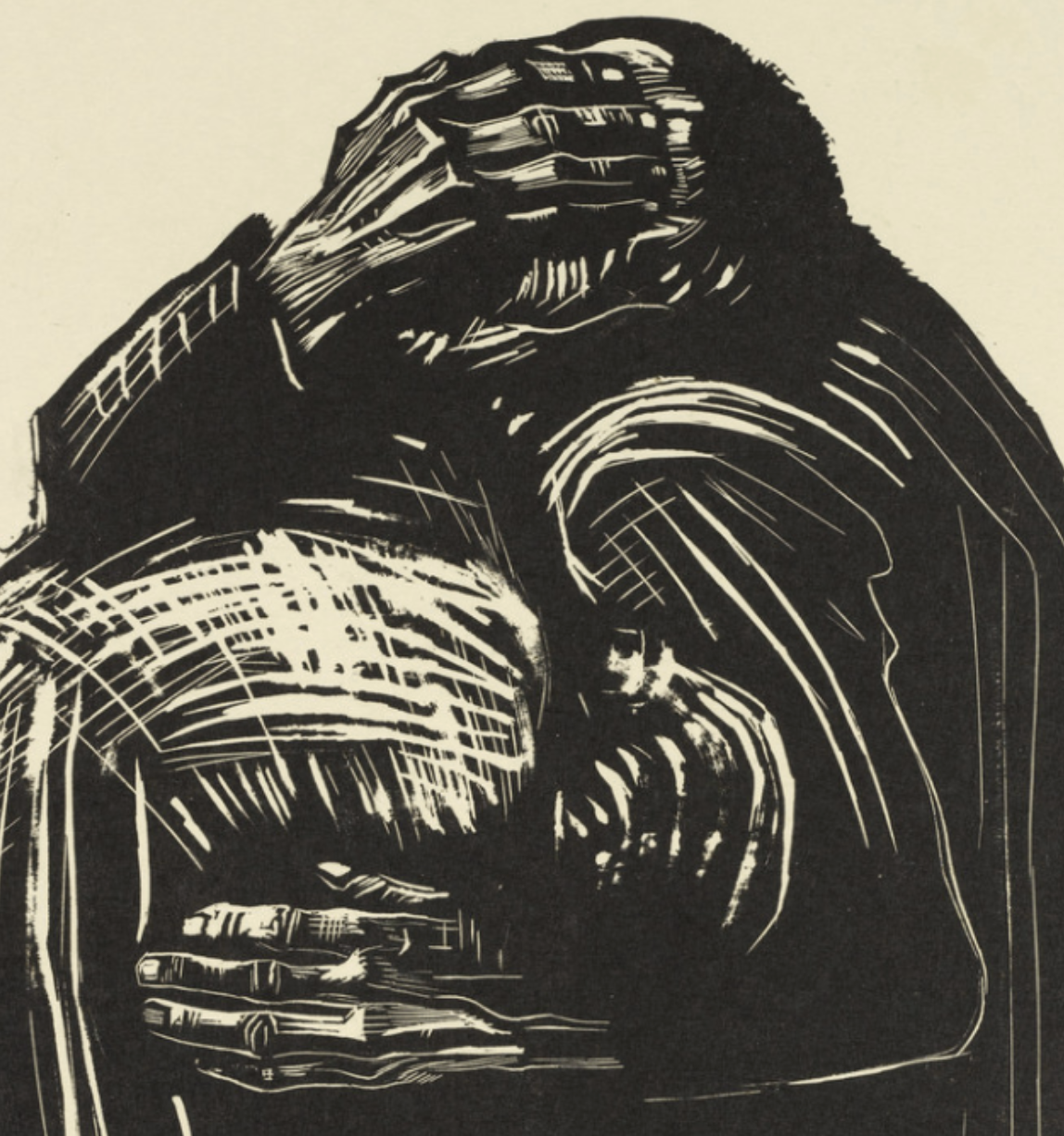
In Die Eltern/The Parents, currently in its final stages of drawing in my process of recreation and master study, the father covers his face with a larger-than-life hand enlarged with details of knuckles and veins and his other hand is the sole support for his collapsed wife. .This scene is directly autobiographical for her acting as a personalized description of her own feelings and experiences.
This is a pieta without the body of the dead. The father’s hands shield his face because his agonized face is too in pain to show the world and his other hand instinctively is the strength of the entire image and centrally focused with incredible fine detail in the knuckles giving a weight and light that illuminates through the white line hatching along the grain of the pearwood plate. The mother’s hair softens nearby as the pearwood’s small soft grain becomes more “circular or fuzzy” and has soft edges around gouges that look worked by various U shaped gouges and knives. There is a softness in the cuts of her hair that gives is body that the father’s hand sinks into.
In a series with no battlefield, no enemy, no weapon, the body's extremities carry the entire weight of the subject and have to carry the work from mere expression of individual grief to a critique on the aftermath of war universally. The feat of her compositions is that war is not in the scene only the subjects of witness, comentary and compassion. Somehow, through only the magnitude and way of the grief does it immediately signal “war tragedy taking a child from their family.” There are few things that will cause humans to breakdown in the manner of these two in Die Eltern, having to bury one’s own child.
Personally, in the course of working the better part of a year on this work, I ran into more emotional experience as a person than I initially anticipated before the project started. It was something I thought about personally before embarking (i.e. - how is engaging with works that a so full of tragedy and sadness going to effect my own feelings and how important is a message so painful at this moment). First, the world is in pain and suffering and I have not personally been close to someone who was lost in armed conflict. That is a privledge of mine and being witness to the atrocities of armed conflict currently in the world was something I wanted to understand and feel for the purposes of shared grief, witness and pledge for pascifism.
But, before starting I had not considered that I am a father myself. I have an elementary age son who is processing peripheral knowledge of war in reality (vs depicted in cartoons, movies or the playground). I have been moved, in grief and tears in the initial 200 hours more than I ever anticipated. I have found myself drawing these initial studies and imagining the grief of losing him who is often sleeping nearby while I am working on this. He has even asked, “why are those people so sad and hurt” when he occasionally has peeked my sketch book. It is a subject that I am still navigating with honesty appropriate to his age while also using this experience to tell him exactly why I am drawing this. My take away from this is that it has had me contemplation on her actual loss of her son as a direct expression built into this composition, and the way it captures the real tragedy and creates the empathy from within to those so that the collective toll is understood by all. This is the definition of being a witness.
IV. As Kollwitz’s Krieg moved to woodcut, Dix sets aside the woodcut and has a return to etching: Der Krieg as Dix’s Exorcism of the Memory
When Dix finally turned to the war directly in Der Krieg (1923–24) he pivoted from the last large folio editioned series of woodcuts to copper plate. The subject, media and gravitas could not have been more divergent than from his Nine Woodcuts. Where woodcut rewards decisive economy, particularly in the prevailing German style, etching asks for mid-tone, micro-gradients of hatching, burishing or using less bite in the plate for burred or smooth edges. The entire detail of the tonal gradients of the plate can border on forensic. And forensic is exactly what Dix wanted. He then used aquatint (another print making medium that uses chemical processes to apply medium to a metal plate, essentially deform it through the process and use those changes in the plate texture to vary the way ink grabs the plate before impression. It can create beautiful hazy textures that layer into traditional scribber etching or it can become quite detailed and be suggestive itself of figures or landscape features.
Dix was on the front lines. He made his Krieg series subjects diametrically opposed to Kollwitz. Furthermore, if Kollwitz represented “all parents suffering loss of a child, especially through armed conflict”, Dix represented “this particular war” that was now almost ten years from outset by the time he directly used the works as purging of memory, his own witness, the disgust of the situation, the absence of heros or victors. His internal nightmares of gas in the trenches, people buried alive all become specific to place and almost regiment or individual.
Paradoxically he said the same exact thing and the literal opposite of Kollwitz:
Kollwitz: These parents are all parents in war throughout history and going forward this is what war will produce
Dix: The global experience of “The Great War” was so universal that he said the equivalent of: I, the individual, will show you what I saw exactly at this horrific moment in history that I witnessed, and it was not just I who saw this but thens of millions of us across the entire continent [My own words and interpretation - not a quote of Dix]
Technically the possibility to manipulate the etching and aquatint mediums serves to heighten the emotional and realistic effects making it feel even more of a direct memory because of its specificity. It is meticulously rendered images of horror. He stopped out ghastly white bones and strips of no man's land, leaving brilliant white patches; multiple acid baths ate away at the images, mimicking decaying flesh. Titles detailing precise places and dates confer an illusion of documentary authenticity.
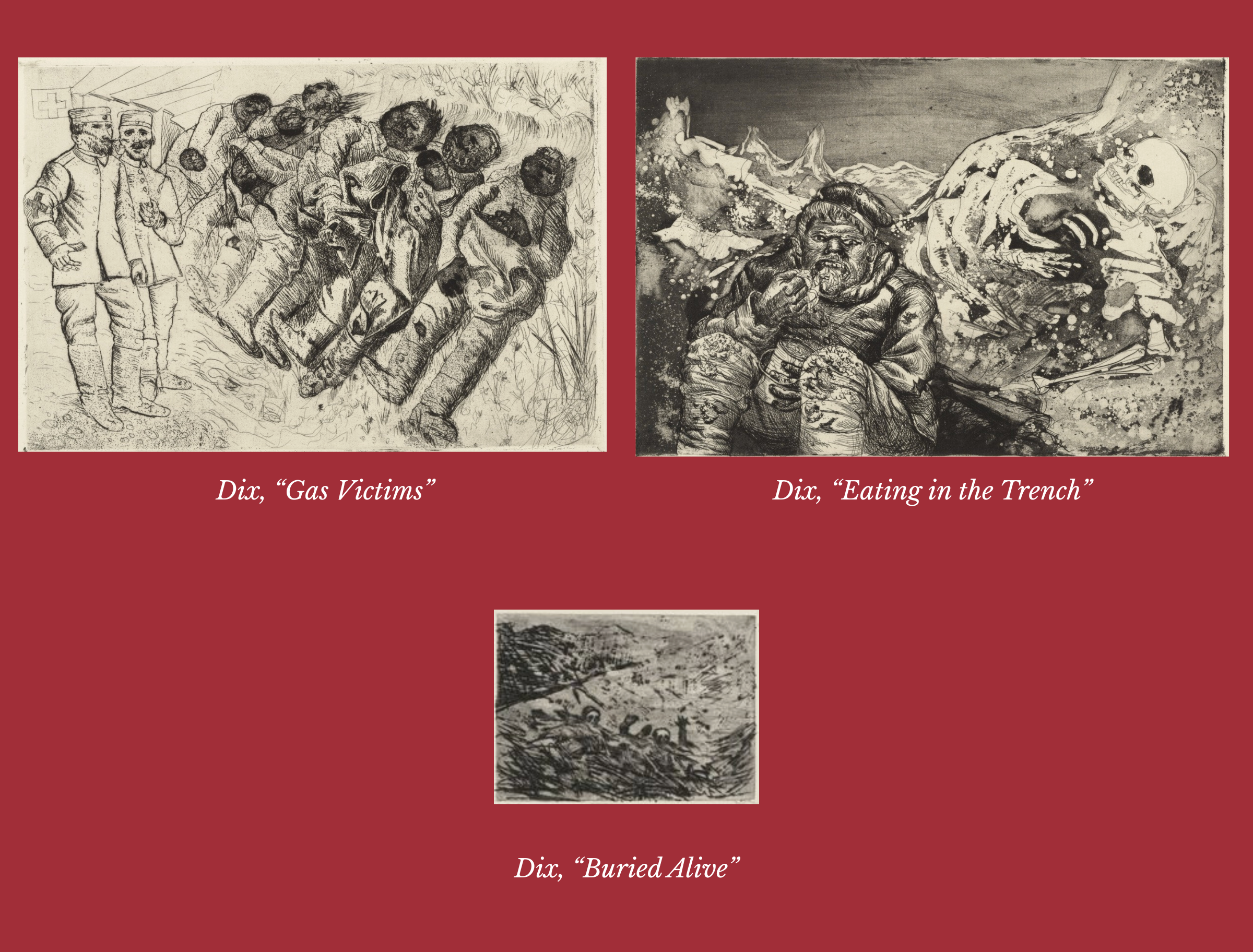
The titles alone tell the story of his method: Buried Alive (January 1916, Champagne). Gas Victims (Templeux-La-Fosse, August 1918). The specificity is insistent, almost prosecutorial that this happened here, on this date, to bodies like this. Dix did not transcribe his wartime sketchbooks; these nightmarish scenes are based on his memories of battle, on photographs (including many that had been censored during wartime), and on catacombs.
The word that surfaces repeatedly in accounts of Der Krieg is "exorcism."
"I did not paint war pictures in order to prevent war. I would never have been so arrogant. I painted them to exorcise the experience of war. All art is about exorcism," -Dix.
V. The Medium Exchange and What It Means
But the exchange is not symmetrical. Dix brought to woodcut the frivolity of postwar city life, and brought to etching the horror of war. Kollwitz brought to woodcut the interior permanence of grief. The medium, in each case, is the argument. Woodcut's bluntness was wrong for Dix's forensic witness; its capacity for absolute black was exactly right for Kollwitz's psychological truth. Etching's capacity for fine, corroded, almost photographic detail was precisely wrong for universal grief but exactly right for the specific hell of a man's memories.
VI. Anti-War or War Documentation? The Ethics of the Question
The prints of Dix’s Der Krieg offered a somber contrast to the numerous monuments honoring the fallen heroes of the conflict, often depicted in full uniform, sleeping peacefully, their noble bodies displaying no signs of wounds. In contrast to these public displays, replete with fluttering flags and martial music, Dix's Der Krieg offered a private recollection, silent but insistent in its focus on the everyday experience of the war and its multitude of horrors.
Dix himself was ambivalent about whether his work could do what pacifists wanted from it. Dix's publisher Karl Nierendorf circulated the portfolio throughout Germany with a pacifist organization, Never Again War (Nie Wieder Krieg - the monumental 1924 lithography of Kollwitz that is one of the most printed anti-war image of the 20th century).
Dix himself doubted that his prints could have any bearing on future wars. His stated purpose was not prevention but testimony to what too many of he and his peers carried with them forward.
Kollwitz never showed the war. She showed only its permanent cost to the living: the parents still kneeling in The Parents, the widows still closed around their grief, the mothers still circling their children in The Mothers. There is no enemy in her Krieg. There is no battlefield, no weapon, no political cause identified. By starkly simplifying and isolating her figures, she concentrates their emotion and makes it universal. The grief she depicts could belong to any war, any country, any century. And sadly, that is why I am within this entire project.
Despite such a distinction, both artists are not showing work that memorialized or romanticizedbattle or used it for allegory like so much 19th century art works (storming the Bastille anyone?).
Dix's title is closer to My War, the war as it lived in him, that he needed to expel. Kollwitz's is closer to War.
To close, I am reminded of the opening words of a movie from late 20th century filmmaker Chris Marker in his diptych from Sans Soliel (1983):
Who said that time heals all wounds? It would be better to say that time heals everything - except wounds. With time, the hurt of separation loses its real limits. With time, the desired body will soon disappear, and if the desiring body has already ceased to exist for the other, then what remains is a wound, disembodied.
This is above poetic truth (and boarder-line koan) reveals that the wound that doesn't heal, sometimes we actually lose sense of memory of the event with fidelity as we age decades later. The details begin to get blurred or mis-remembered, but the wound, the intensity of the pain, it is the one thing that does not seem to heal. This truth is what is captured in both Dix and Kollwitz. This is the horror of war.
Never again war.
