Das Volk: A Final Figure who does not collapse
The Mother of Mercy as a Pillar for the People
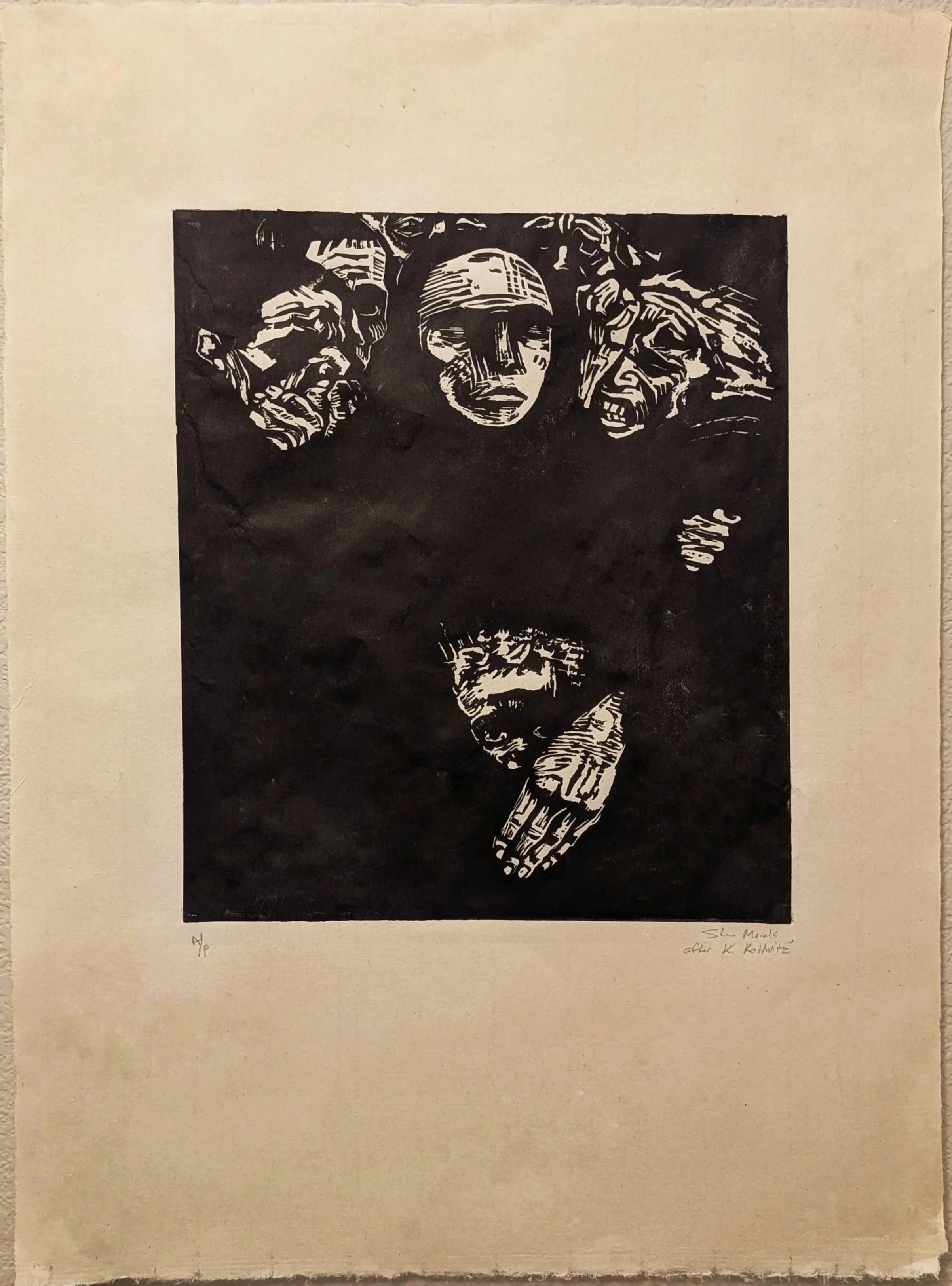
Das Volk (The People), Shane Monds (2026) after K. Kollwitz (1923). Artist proof on Japan laid paper. Oil ink. Paper dimensions: 24.75” x 18.25” ; Image dimensions: approx. 13.75” x 11.8”
Behind the Image: Das Volk
The final plate of the Krieg Series was the first image I began studying in earnest in October of 2025. The seven print folio of Kollwitz's Krieg has a defining arc:
A mother is offering her child, almost akin to Abraham, a parallel Kollwitz herself remarked upon asking why only Abraham was spared the sacrifice.
The young volunteers are enthusiastically looking upward at the opportunity to "grow and become men and take on responsibility," (a sentiment when her 18 year old Peter asked permission to join the war in the opening days as a volunteer). Yet the leader of the troupe is death himself, a figure that would later become the central theme of Kollwitz's later period.
Next, the first widow is the only figure who appears alone, the most interior, the first person who is mourning loss. Her hands show that she is not alone but carrying a child, a fatherless unborn already wrapped in comfort by the mother.
The second widow is the largest and in a striking pose of full exhaustion along a floor, no emotion left to give, her infant child draped over her like a small blanket, receiving comfort and giving it.
Older parents grieving the presumed loss of a late teenage or early twenties youth. It is a pietà with no body, the experience of Kollwitz herself.
The Mothers: the first image of action after the loss, a circle of mothers as a unit becomes one in the composition to protect children while an innocent wide-eyed adolescent peeks from the circle of protection.
Finally, the print of "the people" or "the nation" is a piece that contains layers of subjects. In the closest foreground, a child perhaps bandaged, being guarded by the strong hand of a veiled, stoic figure in the central foreground. This is widely said to be the mother of mercy to which the nation is clinging. The first row shows faces of anguish and despair, hands gripping faces. The second row, people hollowed or terrified. In the back, emptiness of eyes in fear, sadness or worry. All of the nation is unable to attend to one another. The hope lies in the one figure who does not bend, who does not seem destroyed by the war: the face of mercy herself.
I began with mercy because this image is where I wish to pick up, as she left off.
This plate also contains some of the largest solid black fields, the composition being solely of faces and hands, the central theme of the series, which represents the psychology of grief (face) and the duty of survival (hands). The title Das Volk carries more connotation in German and is even a loaded word of the national hubris that promised the war was just in the opening months. By the fourth year, Kollwitz expressed that no objective, no matter how beneficial for the nation, could ever be worth the price paid over the course of the war. No national objective is so important that it would consume its own people.
The body of the mother of mercy is so subtly framed by the surrounding faces as to allude to her veil and outer garments, to which the suggestion of a hand is gripping onto her.
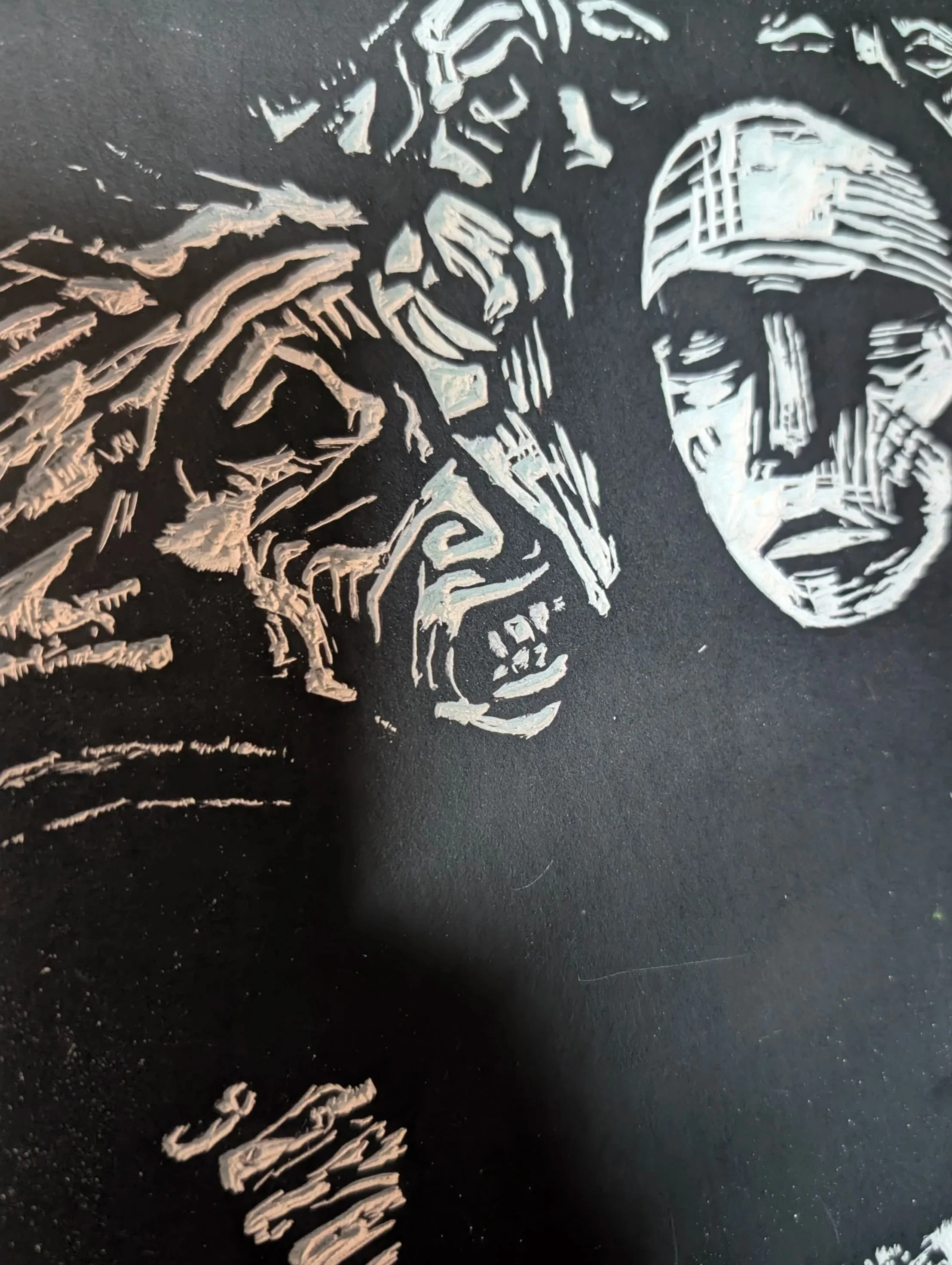
Shane Monds, Plate VII, Das Volk after Kollwitz in process of carving. Detail on the figure grasping the mother of mercy.
In this work, as with all my work in this series, I did study drawings from which I scaled the study and then redrew only the negative space in red pencil and then Micron pen — the red representing what will be removed through carving. The block is stained black, its final printing color. As I carve the red away, it reveals the light grey underneath, simulating what the final result will look like. I work under a 2.5x magnification headset and up to 1200% magnification from high-definition scans of her original. From that original on my tablet at my workbench, I carve observing splinter marks, places where the grain fought her hand, and the type and size of gouges. Cuts arise from small knife work and chisels, or they may be singular strokes of a V-gouge cutting directly through the wood, or small hatches grazing the surface with the finest tools possible. As I work, the exact mark-making energy is the most important thing. Mistakes, if a line is 0.3mm too wide or too narrow, do not affect the impact on the viewer. But the force and depth of the gouge, the intentionality, the intensity, and the detail of the hatching and types of break in the line are what give her work its immediacy.

A look into the carving process
This print becomes the final movement in the folio, a thesis statement of where her country was at the time of publication. The war is over. Soldiers have been buried, some for nearly a decade. These are the people who remain, who will bear the trauma for decades. It is them toward whom we bear witness, and ask for mercy's hand.
I have said it so many times because it is so striking. These images do not read like Germany in the 1920s only. They could be Ukraine, Gaza, Sudan, Yemen, Kashmir, or anywhere today. Only slightly over one hundred years later, these images sadly do not feel like history.
Never again war.
